
 ToronTek-All Rights Reserved
Understanding Fetal Doppler Technology and Fetal Heart Rate Detection
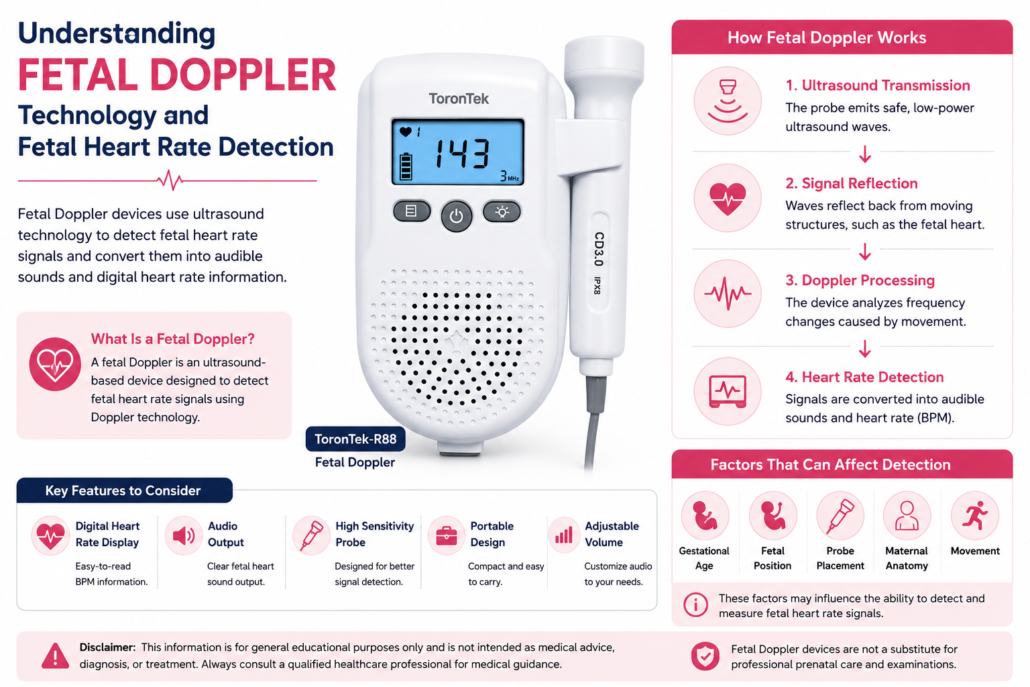
Fetal Doppler technology is widely used to detect and display fetal heart rate signals using ultrasound. By applying Doppler principles, these devices can identify movement associated with the fetal heart and convert those signals into audible sounds and digital heart rate information.
Understanding how fetal Doppler technology works and what factors influence fetal heart rate detection can help users better understand the capabilities of these devices.
What Is a Fetal Doppler?
A fetal Doppler is an ultrasound-based device designed to detect fetal heart rate signals.
The device uses a probe that emits low-power ultrasound waves. When these waves encounter moving structures, such as the fetal heart, the reflected signals are processed and converted into audible sound and fetal heart rate information.
An example of a fetal Doppler device is the [ToronTek-R88 Fetal Doppler].
How Does Fetal Doppler Technology Work?
Fetal Doppler devices utilize the Doppler effect, a principle that measures changes in sound wave frequency caused by movement.
The process typically involves:
- Emitting ultrasound waves through the probe.
- Receiving reflected signals from moving tissues.
- Processing the Doppler frequency shifts.
- Converting the signals into audible sounds and fetal heart rate readings.
This technology allows detection of fetal heart activity and presentation of heart rate information in beats per minute (BPM).
What Information Does a Fetal Doppler Display?
Most fetal Doppler devices provide:
- Fetal heart rate (BPM)
- Audible fetal heart sounds
- Digital display information
- Volume control functions
- Probe-based signal detection
The [ToronTek-R88 Fetal Doppler] features a digital display that provides fetal heart rate information in beats per minute.
What Factors Can Affect Fetal Heart Rate Detection?
Several factors may influence the detection of fetal heart rate signals, including:
Gestational Age
Detection characteristics may vary throughout pregnancy as fetal development progresses.
Fetal Position
The position of the fetus may affect signal acquisition and probe placement.
Probe Placement
Proper probe positioning is important for obtaining fetal heart rate signals.
Maternal Anatomy
Individual anatomical differences can influence signal detection characteristics.
Movement
Maternal or fetal movement may affect signal acquisition and measurement stability.
Why Is Ultrasound Gel Used With a Fetal Doppler?
Ultrasound gel helps improve the transmission of ultrasound waves between the probe and the skin.
Using the recommended coupling gel can assist in optimizing signal transfer and improving detection performance.
Features to Consider When Choosing a Fetal Doppler
When evaluating a fetal Doppler device, users may wish to consider:
Digital Heart Rate Display
A clear display allows easy viewing of fetal heart rate information.
Audio Quality
High-quality audio output can improve signal interpretation.
Probe Sensitivity
Probe performance plays an important role in signal acquisition.
Portability
Compact designs can improve convenience and ease of handling.
The [ToronTek-R88 Fetal Doppler] combines a compact design with a digital fetal heart rate display and integrated audio functionality.
Frequently Asked Questions
What is a fetal Doppler?
A fetal Doppler is an ultrasound-based device designed to detect fetal heart rate signals and convert them into audible sounds and digital heart rate information.
How does a fetal Doppler detect fetal heart rate?
The device emits ultrasound waves and analyzes reflected signals using Doppler technology to identify movement associated with the fetal heart.
What does fetal heart rate mean?
Fetal heart rate refers to the number of times the fetal heart beats per minute and is typically displayed as BPM (beats per minute).
Can fetal position affect signal detection?
Yes. Fetal position, probe placement, gestational age, and movement may influence signal acquisition and detection performance.
What information does the ToronTek-R88 Fetal Doppler provide?
The ToronTek-R88 provides fetal heart rate information through a digital display and audible fetal heart sound output.
Important Disclaimer
The information provided in this article is for general educational and informational purposes only and is not intended as medical advice, diagnosis, or treatment. Fetal Doppler devices are not intended to replace professional medical evaluations, prenatal examinations, or guidance from qualified healthcare professionals. If you have questions regarding pregnancy, fetal health, or fetal heart rate information, consult your physician or healthcare provider.
Related Product
Conclusion
Fetal Doppler technology uses ultrasound and Doppler principles to detect fetal heart rate signals and provide audible and visual heart rate information. Understanding how these devices work, the factors that influence signal detection, and the available device features can help users better understand fetal heart rate detection technology.
 ToronTek-All Rights Reserved
Leave a Reply
Want to join the discussion?Feel free to contribute!